labels: Banks general
UBS reveals US client details to Federal authorities news
11 November 2008

The glamorous image of Switzerland as possibly the most glamorous offshore tax haven, famed for its banking secrecy, and long been home to substantial secret assets from the rich and famous throughout the world, has now been breached with wealth manager UBS  having disclosed information on 70 American clients to the US tax authorities investigating tax evasion.

The reveling of the 70 American account holders in UBS came when the US authorities requested the Swiss to reveal names of Americans holding 'undeclared' accounts in UBS as it was required by the US Justice Department to investigate accounts which was not declared to the Internal Revenue Service.
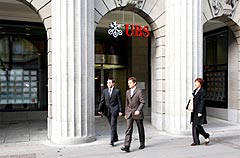
The US Justice Department's request was based on the revelations of a former UBS employee, Bradley Birkenfeld, who cooperated with the authorities in revealing details of accounts in lieu for a lighter sentence in a case where he pleaded guilty for helping a real estate developer conceal $200 million and evade $7.2 million in taxes.

UBS business methods were disclosed by Birkenfeld to the Senate, who concluded that UBS had broken the US banking and securities law.

At a Senate hearing, Mark Branson, a senior UBS executive admitted that misconduct had occurred and said approx 19,000 Americans held undeclared accounts with the bank in Switzerland.

Investigators have also managed to lay their hands on an additional 30 American holders of undeclared UBS accounts from whistle blowers who are entitled to get 30 per cent of the money IRS is able to recover with their input.

Switzerland only provides information about clients of banks when competent law enforcement agencies from different countries are able to present concrete evidence of criminal activity by a client.

The 70 names disclosed do not come under this purview as the US Justice Department were not in possession of any evidence but merely asked information of American citizens who held accounts in UBS. The disclosure of names and accounts will help the investigating authorities to investigte if the account holders have broken any US laws.

The Justice Department and the Securities and Exchange Commission have also been investigating UBS's role in servicing American clients from Switzerland.

Commentators feel that although UBS's swiss-based accounts were under scrutiny, US regulators would have clamped down heavily on the bank if it chose not to cooperate as it had wide operations in the US.

President-elect, Barack Obama,  who had called UBS "tax cheats",  plans to crack-down on international tax havens and has signalled he will introduce a law within weeks of taking power, as part of a wide ranging revenue raising and tax reform package where the crackdown that could raise at least $50 billion a year in lost US tax revenues.

The Swiss government has been under great pressure from Germany and other EU countries to abandon its policy of not revealing bank client details.

Switzerland is not a tax haven in reality but rather a place where one can hide assets and lock them up far away from prying eyes and be safe in the knowledge that no one can ever get their hands on them again.

Very close to the US is another tax haven for the rich and famous, Bahamas, which has an incredibly strong network of laws that offer unbreakable levels of secrecy and privacy to anyone utilising its offshore company, banking and trust services.

Barbados and Bermuda have long been popular with American companies seeking to reduce their overall income and profits tax, withholding tax, capital gains tax, capital transfer tax and inheritance tax liabilities.

British Virgin Islands are also very attractive to many people since 1984 when the International Business Companies Act was passed.

Panama uses the US dollar and its banks are well positioned to survive the global credit crisis and there is no Federal Reserve or central bank to interfere in the markets.

Panamanian banks maintain a solid 58 per cent loan to holdings ratio, which puts the banks in a strong position, compared to major US banks that have had to resort to billions in federal bailouts to stay afloat.

The Isle of Man, Liechtenstein, Luxembourg, Andorra, the Cayman Islands, Grenada, Cyprus, Malta, Monaco, Belize, Jersey and Guernsey are some of the other tax havens in the world.

Vanuatu is quite possibly the world's best or worst tax haven. Vanuatu is an island archipelago state in the Pacific, it's also a tax haven that maintains absolute client confidentiality and will not release any account information to governments or law enforcement agencies no matter how much evidence they may have against an individual or corporation.

Vanuatu is suspected as having been used as a mechanism for international transfers of cash in many, many illegal transactions.

Intetrestingly, none of the banks operating in thse tax havens have been affected by the current meltdown that has brought some of the most venerable banks on their knees.


 search domain-b
  go
 
UBS reveals US client details to Federal authorities