Infrastructure bonds - A Rs.200bn opportunity for banks: CRISIL
Executive Summary
24 July 2006
The proportion of long-term loans in bank portfolios has increased with the growth in lending to the infrastructure and housing sectors, but banks have at the same time increasingly borrowed short-term, mainly to manage margins. Given the hardening of interest rates, this strategy is a risky one, as it has contributed to increasing asset-liability maturity (ALM) mismatches. Consequently, to counter ALM mismatches and to encourage lending to the infrastructure sector, the Reserve Bank of India (RBI) in June 2004 permitted banks to raise long-term bonds with a maturity of five years and above; these bonds could only be used to fund outstanding infrastructure loans with a residual maturity greater than five years.
However, most banks did not effectively leverage this opportunity: to maintain profitability, they continued to rely on short-term borrowing. Given the rising interest rate scenario, CRISIL believes that banks will need to revisit this strategy. In the notification enabling the issue of infrastructure bonds, CRISIL sees a Rs.200 billion opportunity for Indian banks to leverage the hitherto unutilised long-term bond opportunity. Making use of this opportunity can help banks reduce the risk of large ALM mismatches, and broaden their resource base.
The increasing use of short-term deposits for long-term funding
The share of industry advances in gross bank credit, though declining in recent times, has continued to be prominent; as on March 31, 2005 it stood at 37.7 per cent of total credit. Within this, the share of infrastructure advances has steadily increased: as a percentage of banks' credit to industry, infrastructure advances have grown to 15.5 per cent as on March 31, 2005, from a meagre 2 per cent as on March 31, 1998. This is one of the reasons for the share of long-term loans in the total loans and advances profile increasing significantly to 45 per cent as on March 31, 2005 (please refer chart 1), from less than 25 per cent as on March 31, 1998. Over the same period, the share of short-term deposits, grew to 39.4 per cent of total deposits, from 27.7 per cent (please refer chart 2). Effectively, this meant that banks were funding more of their long-term advances through short-term deposits, thereby widening the ALM gap.
Chart 1: Tenure of outstanding loans and advances of Scheduled Commercial Banks (SCBs)
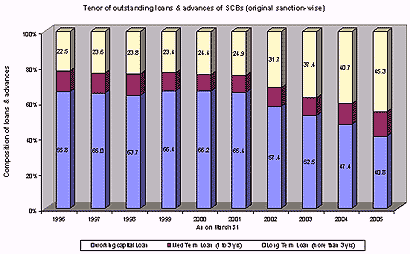
Source:RBI
Chart 2: Maturity pattern of terms deposits of SCBs
