|
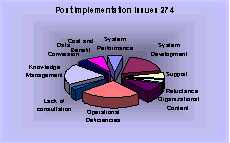
In the second part of a three-part series, M Alagappan* spells out critical success factors in any ERP implementation Customer feedback solicited at the end of projects gives interesting insights about practical difficulties in ERP implementation. The survey results, shown in the figure below, illustrate issues recorded as feedback from 61 respondents across 10 major-issue categories.  The respondents were diverse in terms of business domains (medicine, technology, services), core business models, the market position of the company, the globalisation component of the business, geography (Ireland, USA) and the type of products (pharmaceutical, computers, electronic goods). | It is, in fact, quite surprising to note that the choice of ERP package itself ranks at the bottom of the Top Ten list of critical success factors of any implementation | The main implementation risks cited with ERP projects are two-pronged. First, there are change management issues. Second, handling the business re-engineering that results from switching to the ERP's elemental business model. Takeaway: Critical success factors  Top management support: If top management is not actively backing an all-pervasive project like an ERP implementation, there is little hope for such a project to succeed. This is especially so in the early stages. Project team competence: This critical success factor (CSF) is one of those that was originally not very high on Somers and Nelson's (2001) list but that ended up remarkably high when the customers were asked to do the ranking. Interdepartmental co-operation Clear goals and objectives Project management Interdepartmental communication: The importance of communication across different business functions and departments is well known in IT implementation literature. Management of expectations: Successfully managing user expectations has long been known to be important for successful implementation of IT systems in general. Project champion: The success of technological innovations has often been linked to the presence of a champion, who performs the crucial functions of transformation leadership, facilitation and marketing the project to the users; for example the chief information officer (CIO). Vendor support: A project as all-pervasive as an ERP implementation cannot be delegated to an outside party. In fact, too strong a reliance on outside consultants or vendor support was found to have a negative correlation with project success. Careful package selection: ERP vendors may claim that their systems are overlapping in functionality but they are not, at least not in full. It is, in fact, quite surprising to note that the choice of ERP package itself ranks at the bottom of the Top Ten list of critical success factors of any implementation. It is also important to mention here that these critical success factors are linked and hence reinforce each other in the same direction. The business implications mean that the progress would either get into a vicious or a virtuous cycle of ERP performance. The core process on any successful implementation consists of mutually reinforcing communication and collaboration between project team members from different departments and business functions. If this core process of communication and collaboration under-performs, it is very likely that the presence and/or attitude of several of the key stakeholders like the top management, the project team, the project management team, the project champion, the package vendor, etc, would also prove to be insufficient. *The author is a freelance columnist and a practicing ERP implementation engineer at a multinational investment firm. He can be contacted at alagappan.m@gmail.com
also see :
Part III: The information business Part I: Oracles or Saps?
|