|
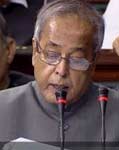
Pranab Mukherjee, the veteran Congress leader from West Bengal, is almost certain to become the country's new finance minister as commentators have put him ahead in the race with Montek Singh Ahluwalia, deputy chairman of the Planning Commission. Mukherjee was temporarily in charge of the finance ministry in the last government after P Chidambaram moved to home ministry in the backdrop of Mumbai terror attack. (See: Security shuffle: A change of rooms for Chidambaram) During his latest stint in the finance ministry, Mukherjee presented the interim budget on February 16, 2009, and unveiled a stimulus package that included lowering of retail fuel prices, cutting taxes on consumer products and injecting capital into state-run banks. (See: Budget sops were not needed, government had done enough) It was exactly a quarter of a century ago in February 1984 that Mukherjee last presented the Budget in the Parliament, when he was the cabinet minister of finance from January 1982 to December 1984 with additional charge of ministry of commerce and supply. However, with the assassination of Indira Gandhi in 31 October 1984, his fortunes began to dip. From being No. 2 in the cabinet, Mukherjee was banished to the outer darkness of politics by Rajiv Gandhi. It was another three years later, after Rajiv's assassination in 1991, Narasimha Rao rehabilitated Mukherjee as external affairs minister. Mukherjee presented his first Budget in 1982. The country had just emerged from a period of high inflation that had reached an all-time high of 21 per cent during Chaudhury Charan Singh's tenure as finance minister. It also coincided with the signing for an IMF loan, which the US had opposed saying that India would utilise the money for buying arms. ''When I took charge, foreign exchange reserves were in abysmal shape. My predecessor, R Venkataraman (who went on to beclome the country's next president), had signed that agreement with the IMF for an SDR of US $5 billion in November-December 1981 but it had to be implemented during my regime,'' Mukherjee recalled later in an interview. However, Mukherjee didn't mention about the loan in his Budget speech. He focused on housing / real estate and said, ''I propose to exempt from tax long-term capital gains arising from the transfer of other assets where the net consideration is invested by the taxpayer in a residential house.'' His next Budget was much like the first one, also a play with tariffs, rates and customs duty on every imaginable sort. Mukherjee referred to the ''uncongenial external environment marked by rising protectionism, demand recession and near stagnation in world trade. This Budget also set up the Fourth Pay Commission. His last Budget in 1984 has been acclaimed as one giving a variety of concessions. Mukherjee said in his 1984 Budget speech, ''Industrial growth in the current year is likely to be around 4.5 per cent. This is well below the potential of the industrial sector. We must aim at a growth rate of 7 to 8 per cent in industry if we are to maintain high rate of growth of GDP and provide employment for our growing labour force in the years ahead... National income growth is likely to be in the range of 6 to 7 per cent.'' The remarks seem almost relevant to the current situation. Mukherjee was seen as a progressive leader with a long vision, and Euromoney voted him the best finance minister in 1984. Noted economist Kaushik Basu, however, had a different opinion. ''Some of his 1984 'concessions' may not be concessions at all when viewed in the light of our double-digit inflation,'' he wrote in the Economic and Political Weekly in a review of the Budget. ''Moreover, it is likely that this budget will fuel inflation, thereby removing in the long-run what minimal concessions the fixed-income classes may be receiving in the immediate future…It keeps the tax rates progressive on paper so that the poor feel happy. It keeps a blind eye on tax-evasion, this keeps the rich happy. In this situation there is very little that a budget can achieve,'' he added. The 1984 Budget acknowledged the IMF loan for the first time by saying that India would not avail itself of the final tranche of $1.1 billion. However, with the formation of P V Narasimha Rao government in 1991, the country systematically liberalised its economy by removing complex restrictions, and foreign-exchange controls. Tariff rates averaging well over 120 per cent (and rising as high as 400 per cent) were also brought down. Successive governments have continued on the progressive track presenting major changes with every budget since the beginning of the reform programme. The big question now is to what extent, Mukherjee, if eventually named the finance minister on 22 May, will be able to continue with economic reforms in the backdrop of the worst global economic decline in over half a century since WWII. The general mood is that with no strings attached due to a clear mandate from the people, nobody can stop the new government from implementing new ideas and pushing the reforms further, and the new finance minister will have a key role to play in delivering on the new government's poll promises.
|