Making higher energy light to fight cancer
12 Dec 2019
1
Scientists at the University of California, Riverside and The University of Texas at Austin have demonstrated that it is possible to achieve photon up-conversion, the emission of higher energy light, when using carefully designed structures containing silicon nanocrystals and specialised organic molecules.
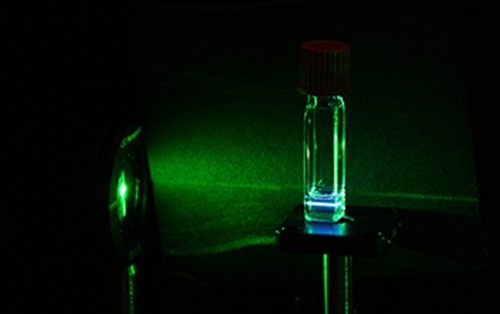
(Credit: Lorenzo Mangolini & Ming Lee Tang/UCR)
The NSF-funded discovery, published in Nature Chemistry, brings scientists one step closer to developing minimally invasive photodynamic treatments for cancer. The advance could also hasten new technologies for solar-energy conversion, quantum information, and near-infrared driven photocatalysis.
High energy light, like ultraviolet laser light, can form free radicals able to attack cancer tissue. Ultraviolet light, however, doesn't travel far enough into tissues to generate therapeutic radicals close to the tumor. Near-infrared light penetrates deeply but doesn't have enough energy to generate the radicals.
While photon up-conversion can overcome this limitation, up-converted materials have low efficiency or high toxicity. Silicon is known for being nontoxic, but researchers had not been able to demonstrate that silicon nanocrystals can up-convert photons, leaving this promising cancer treatment tantalisingly out of reach.
Scientists attacked this problem by studying the surface chemistry of silicon nanocrystals. The team learned to attach ligands, which help bind molecules together, to a nanoparticle. The ligands are designed to transfer the energy from the nanocrystals to surrounding molecules.
The scientists then shined laser light into a solution. They found that silicon nanocrystals with appropriate surface ligands can rapidly transfer energy to surrounding molecules.
"This discovery would not have been possible without collaboration between one NSF-funded group conducting basic research on photon up-conversion with another NSF-funded group conducting basic research on silicon nanoparticles," says George Janini, a programme director in NSF's Division of Chemistry. "Investment in basic chemistry and materials research advances knowledge and contributes to national health, two of NSF's strategic goals."