Storing data in individual molecules
By By Larry Hardesty, MIT News Office | 24 Jan 2013
Moore's law - the well-known doubling of computer chips' computational power every 18 months or so - has been paced by a similarly steady increase in the storage capacity of disk drives.
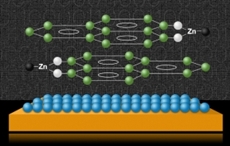 |
| The new molecules are known as 'graphene fragments,' because they largely consist of flat sheets of carbon (which are attached to zinc atoms). That makes them easier to align during deposition, which could simplify the manufacture of molecular memories. Graphic: Christine Daniloff/MIT |
In 1980, a hard drive could store about a half-megabyte of data in a square inch of disk space; now, manufacturers are closing in on a million megabytes of data per square inch.
An experimental technology called molecular memory, which would store data in individual molecules, promises another 1,000-fold increase in storage density. But previous schemes for molecular memory have relied on physical systems cooled to near absolute zero.
In the 23 January online edition of Nature, an international team of researchers led by Jagadeesh Moodera, a senior research scientist in the MIT Department of Physics and at MIT's Francis Bitter Magnet Laboratory, describes a new molecular-memory scheme that works at around the freezing point of water - which in physics parlance counts as ''room temperature.''
Moreover, where previous schemes required sandwiching the storage molecules between two ferromagnetic electrodes, the new scheme would require only one ferromagnetic electrode. That could greatly simplify manufacture, as could the shape of the storage molecules themselves: because they consist of flat sheets of carbon atoms attached to zinc atoms, they can be deposited in very thin layers with very precise arrangements.
The storage molecules were developed by chemists at the Indian Institute of Science Education and Research in Kolkata, who are co-authors on the Nature paper. The Indian chemists believed that the molecules could be useful for the type of experimental devices studied by Moodera's group, which use ''spin,'' a property of tiny particles of matter, to represent data.